Deep Diaries · · 4 min read
Rethinking How AI Learns: Why Backpropagation Doesn't Quite Match the Brain
A look at new research on the structural differences between deep neural networks and human visual processing.
Originally published on Deep Diaries on Substack. Reproduced here as written.
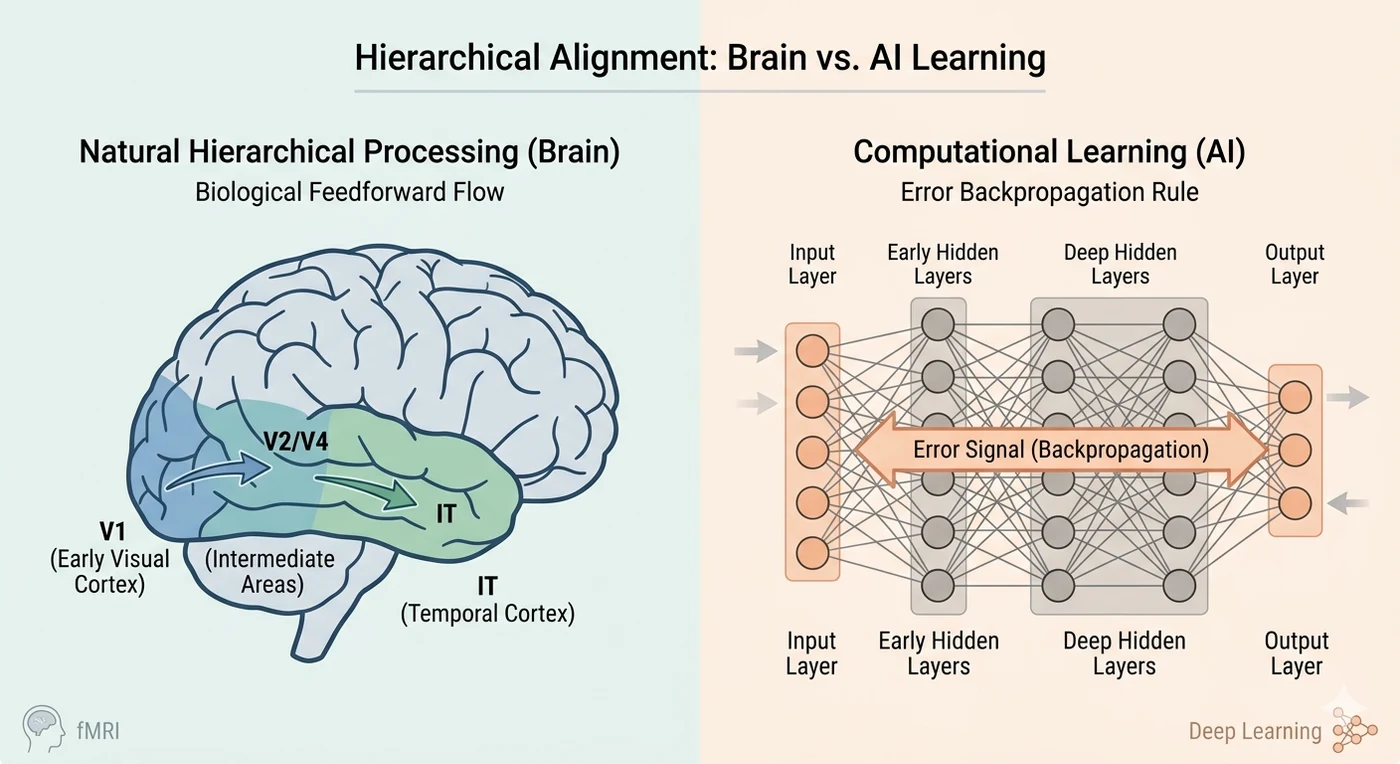
We often hear deep learning described in biological terms. When a deep neural network (DNN) processes an image, it passes data through multiple layers, much like the human brain processes visual information through the ventral visual stream—starting from basic edges and shapes in the early visual cortex (V1) and building up to complex object recognition in the inferior temporal cortex (IT).
Because of this structural similarity, DNNs have become the standard computational models for predicting how the brain responds to visual stimuli. However, a persistent question has always divided computer scientists and neuroscientists: How do these networks learn?
The standard method for training DNNs is a mechanism called error backpropagation (often just called backpropagation, or BP). While BP is incredibly effective at optimizing networks to perform complex tasks, neuroscientists have long argued that it is biologically implausible. A recent 2026 paper titled “Misalignment Between Backpropagation and the Hierarchy of Brain Responses to Images” provides compelling evidence that while backpropagation works well for software, it fundamentally misaligns with how the human brain organizes information.
Let’s break down the research, what it found, and why it matters for the future of artificial intelligence.
The Problem with Backpropagation
To understand the research, we first need to look at why backpropagation is viewed with skepticism by biologists.
When a standard AI model makes a prediction, it compares its answer to the correct answer. The difference between the two is the “error.” In backpropagation, this error signal is sent backward through the network, from the final output layer all the way to the first input layer, adjusting the mathematical weights of each connection along the way.
The biological brain does not appear to work this way. Backpropagation requires a global error signal, symmetric synapses (the “weight transport” problem), and the pausing of incoming information while the backward adjustments are made. In contrast, the brain seems to update its connections locally and continuously, with information flowing primarily forward.
Recently, researchers have developed “forward-learning” algorithms for AI—methods like predictive coding that update weights locally and sequentially without relying on a global backward pass. The authors of the new study set out to see if models trained with these biologically plausible forward-learning methods matched the human brain better than those trained with traditional backpropagation.
The Experiment: Mapping AI to the Human Brain
The researchers conducted a large-scale comparative analysis. They took several popular DNN architectures (including ResNet, ViT, and CLIP) trained via standard backpropagation, alongside models trained using newer forward-learning algorithms.
They then compared the internal representations of these AI models to two major neuroimaging datasets of humans viewing thousands of natural images:
An fMRI dataset, which provides high-resolution spatial maps of where information is processed in the brain’s visual hierarchy (from V1 to IT).
An MEG dataset, which provides precise, millisecond-by-millisecond temporal data on when information is processed.
The goal was to calculate a “Hierarchical Alignment Score.” If an AI model processes information like a human, its early layers should match early brain regions (and early milliseconds of processing), and its deep layers should match later, higher-level brain regions.
The Findings: A Structural Misalignment
The results of the study highlight a distinct difference between optimization and biological emulation.
1. Backpropagation Jumbles the Hierarchy: The researchers found that while BP-trained models are highly accurate at predicting overall brain activity (they know what the brain is seeing), their internal hierarchy is disorganized. The intermediate processing steps of a BP network do not neatly map onto the intermediate regions of the human brain. Because backpropagation forces deep layers to heavily dictate the updates of early layers, the strict forward progression seen in biological perception gets broken.
2. Forward-Learning Restores the Order: Conversely, the models trained with forward-learning algorithms demonstrated a much stronger, monotonic alignment with the human brain. Their early layers mapped cleanly to the V1 cortex and early temporal responses in the MEG data, progressing sequentially up to the IT cortex and later temporal responses. The “diagonal” alignment matrix showed that these models process information in a step-by-step manner that closely mirrors human biology.
3. The Learning Rule is the Deciding Factor: Interestingly, the researchers noted that whether the AI was trained using supervised learning (with labels) or unsupervised learning (without labels) was secondary. The primary driver of biological alignment was the learning rule itself: how the system distributes credit and updates its internal structure.
Why This Matters
For practical, everyday software applications, backpropagation remains an exceptional, highly efficient tool. If the goal is simply to build an image classifier that works, the internal misalignment with the human brain is not a pressing issue.
However, if the goal of artificial intelligence research is to build systems that truly understand and interact with the world the way humans do—or to use AI as a tool to unlock the mysteries of neuroscience—this paper suggests a necessary shift.
By relying exclusively on backpropagation, we are building systems that achieve human-like results through distinctly non-human processes. The success of forward-learning algorithms in this study indicates that bringing AI training methods closer to biological reality doesn’t just satisfy neuroscientists; it creates architectures that fundamentally process information the way we do.
As AI continues to integrate into more complex cognitive tasks, looking toward the biological constraints of the human brain might provide the blueprint for more robust and naturally aligned computational systems.
Thank you for reading. If you found this breakdown helpful, consider subscribing for more deep dives into the mechanics of artificial intelligence and cognitive science. What are your thoughts on biologically inspired AI? Let’s discuss in the comments.